
A home built in the 1950s may have a basement constructed with concrete masonry units, commonly called CMU or concrete block. If you are buying an older Chicagoland home, the question is not simply how old the foundation is. The more useful question is: What condition is it in today?
An older block basement deserves a careful look at the walls, mortar joints, drainage, and evidence of past repairs. Understanding those observations can help you decide what needs maintenance and what needs further evaluation before closing.
What Is a CMU Basement?
CMU walls consist of individual masonry units joined with mortar. Unlike a poured concrete wall, a block wall has horizontal and vertical joints throughout its surface. Units may have hollow cores; construction can also include grout and reinforcing steel. The building's age alone does not establish what is inside the wall.
People often use “cinder block” and “concrete block” interchangeably, but the terms do not necessarily describe the same aggregate composition. A visual inspection cannot reliably identify every concealed material or construction detail.

Moisture Stains and White Deposits
Dampness can come from water entering through the foundation, moisture moving through porous masonry, or condensation on cool surfaces. Staining, peeling paint, and a musty odor are reasons to investigate the source rather than immediately cover the wall.
A white, powdery deposit may be efflorescence: salts left behind as moisture evaporates. It is not, by itself, proof of mold or structural failure. It does indicate moisture movement has occurred; one dry inspection cannot establish whether that condition is seasonal or fully resolved.
Cracks: Look Beyond the Width
Crack direction, location, displacement, and surrounding conditions all matter. A single measurement does not establish that a wall is safe.
- Stair-step cracks follow mortar joints and warrant evaluation in context, particularly when accompanied by separation or movement.
- Horizontal cracks and inward bowing raise concern about the wall's ability to resist lateral pressure.
- Offset blocks or separation near corners can indicate displacement that needs professional assessment.
A patched crack does not establish that movement has stopped. If a wall is bowed, displaced, or significantly cracked, obtain an evaluation from a licensed structural engineer before relying on a cosmetic repair or choosing a stabilization system.

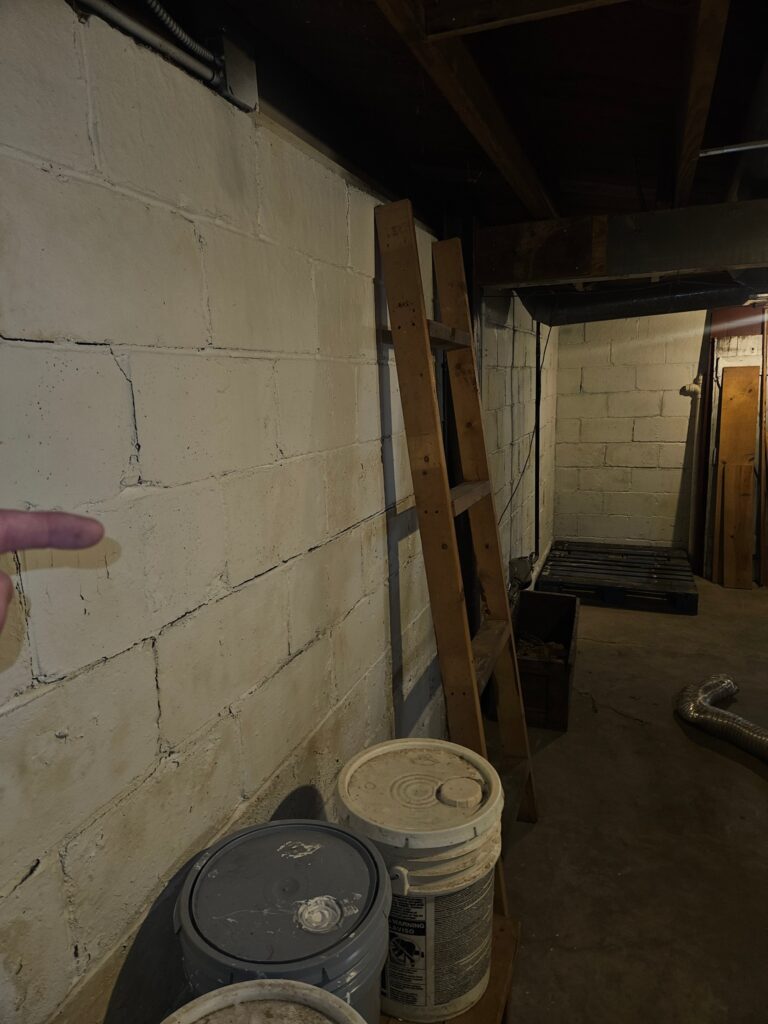
These photographs illustrate visible masonry conditions; they do not establish the building’s construction date or confirm the cause or extent of movement.
Crumbling Mortar and Flaking Block Faces
Look for missing joints, loose material, and surfaces that are breaking or flaking away. These observations should be documented rather than dismissed as normal simply because the basement is old. A qualified masonry professional can assess deterioration and appropriate repairs; structural movement calls for an engineer's evaluation.
Start Outside When Investigating Water
Water management involves more than an interior coating. Check whether gutters overflow, downspouts discharge beside the foundation, nearby surfaces direct runoff toward the home, or window wells collect water. Foundation drainage and exterior protection may also need assessment.
A dehumidifier can reduce indoor humidity, but it does not correct water entering through a wall. Likewise, paint does not stabilize a moving foundation. Resolve moisture and structural concerns before installing finishes that hide the masonry.
Questions to Ask Before Buying or Finishing the Basement
- Has water entered after heavy rain or snowmelt?
- What repairs were performed, and are engineering reports, permits, invoices, or warranties available?
- Are cracks changing, or have patches reopened?
- Will finished walls, stored belongings, or insulation limit inspection access?
- Does the repair proposal address the diagnosed cause as well as the visible symptom?
Have the Basement Evaluated Before You Commit
A home inspection is a non-invasive evaluation of accessible conditions at the time of the visit. It cannot confirm concealed reinforcement, expose covered walls, or guarantee future dryness. Findings may lead to recommendations for additional evaluation.
Our home inspection services help buyers and homeowners understand visible property conditions and plan their next steps. With over 380 five-star reviews, Mike Knapczyk provides clear explanations and detailed photo reports.
Call or text 708-770-6522 to discuss your home inspection, or schedule online.
Illinois Home Inspector License #450.011540



